
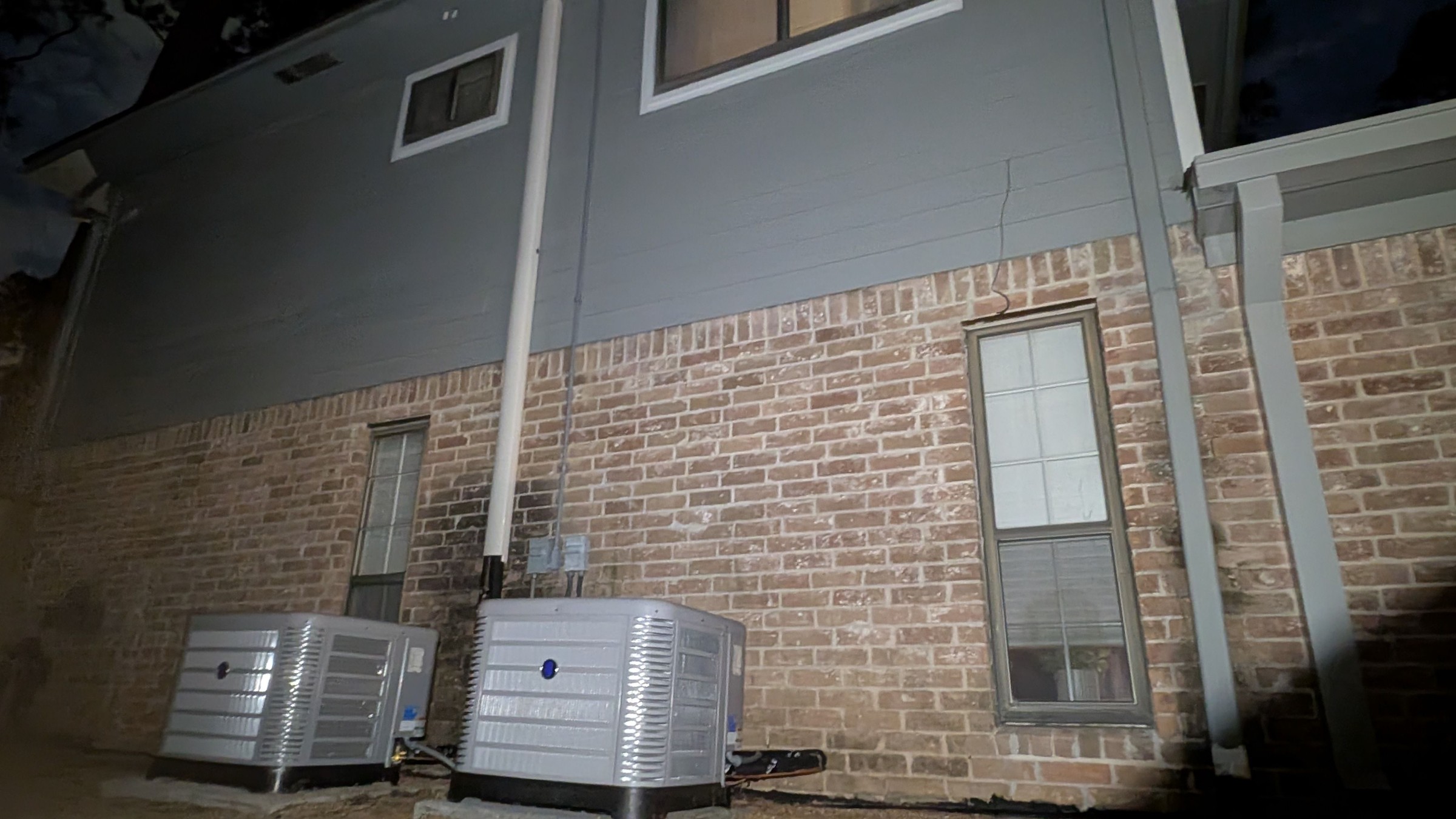
You can usually tell in a minute. Turn the heat on and look at the outdoor unit. Check the thermostat for an AUX or EM HEAT setting. Then look at the indoor unit for a gas line and a metal vent pipe. If the outdoor unit runs in heat mode and there's no gas line, it's a heat pump. If the outdoor unit sits still and there's a gas line and flue, it's a gas furnace.
Check 1: The outdoor unit in winter
Set the thermostat to HEAT a few degrees above room temperature and go outside. A heat pump uses the outdoor unit to make heat, so it will run, with the fan spinning. If you have a gas furnace with a regular AC, the outdoor unit only runs for cooling. In heat mode it sits still.
Check 2: The thermostat
Look at the thermostat's modes and screen. Settings like "AUX" or "EM HEAT" (emergency heat) usually mean a heat pump. Those settings run backup heat when the heat pump needs help. A thermostat with only HEAT, COOL and OFF doesn't prove much either way, so move on to the next check.
Check 3: The indoor unit
Find the indoor unit, often in the attic, a closet or the garage. Signs of a gas furnace:
- A gas line running to it, usually with a shutoff valve
- A metal flue or vent pipe going up through the roof
- A small window where you can see a flame when it's heating
Just look. Don't touch or turn the gas valve. If you don't see any of these, the indoor unit is likely an air handler, which goes with a heat pump or electric heat.
Check 4: Labels and paperwork
The indoor and outdoor units each have a data plate with the model information. A heat pump is usually labeled as one. Your install paperwork or past service invoices may say too. If the labels are hard to read, take a photo and send it with your service request.
What about dual-fuel (both)?
Some homes have both: a heat pump outside and a gas furnace inside. That's called a dual-fuel system. The heat pump does most of the heating, and the furnace takes over when it gets colder. If your outdoor unit runs in heat mode and you also see a gas line and flue on the indoor unit, you may have one.
Why it matters
Knowing what you have changes how you troubleshoot and what a tune-up covers. A heat pump that runs outside in winter is normal. A furnace whose outdoor unit runs in heat mode is not. And homes with gas heat should have a working carbon monoxide alarm.
Getting ready for the first cold front? Our fall AC-to-heat checklist walks through what to check. If the heat has already quit, see what to do when the heat goes out.
Thinking of switching?
If you're weighing a change from one to the other, our article on gas vs. electric heating lays out the trade-offs.
Still not sure?
A technician can tell you on any visit. If the heat isn't working right, see heating and furnace repair, or request service and tell us what you're seeing.
FAQ
How can I tell if I have a heat pump or a furnace?
Turn the heat on and look outside. If the outdoor unit runs in heat mode, it's likely a heat pump. If it sits still and the indoor unit has a gas line and a metal flue pipe, it's a gas furnace.
Does a heat pump have an outdoor unit?
Yes. A heat pump's outdoor unit runs for both heating and cooling. With a gas furnace and AC, the outdoor unit only runs for cooling.
What does AUX heat on my thermostat mean?
AUX means auxiliary, or backup, heat. It's usually found on heat pump systems and runs when the heat pump needs help warming the house.
Can a home have both a heat pump and a gas furnace?
Yes. That's a dual-fuel system. The heat pump handles most heating, and the gas furnace takes over when it gets colder.
Does a heat pump need a CO detector?
Any home with gas appliances, including a gas furnace, should have a working carbon monoxide alarm. Many homes with heat pumps have other gas appliances too, so check what's in your house.
Who can check my system in Tomball or Spring?
Velocity Air can. We work in Tomball, Spring and nearby towns. Open 24 hours, Monday–Saturday. Closed Sunday. Call (832) 589-0813 or request service online.
From all of us at Velocity Air A/C & Heating