
Commercial HVAC Assessments: What We Look For Before Cooling Season Starts
- Velocity Air A/C & Heating

- Mar 2
- 5 min read
In Houston, commercial cooling systems transition from intermittent operation to sustained load within weeks. As temperatures rise and humidity increases, rooftop units move from moderate cycling to extended run times with little recovery window.
Systems that have not been evaluated prior to peak demand experience higher failure rates, increased energy consumption, and accelerated equipment wear.
Many mid-summer emergency calls begin with the same phrase: “It was running fine last month.” And that is often true.
Sustained cooling demand does not create most failures - it exposes the weaknesses that were already developing.
Early spring is one of the most important windows of the year for structured commercial HVAC assessments.
At Velocity Air A/C & Heating, our pre-season commercial evaluations are designed to identify performance drift, mechanical stress, and system imbalances before peak load magnifies them.
Here is what we look for - and why it matters.
Electrical Components Under Sustained Load
Electrical stress is one of the most common contributors to commercial HVAC downtime during peak season.
Under moderate spring temperatures, components such as contactors and capacitors may appear functional. But once rooftop units begin cycling less and running longer, small electrical weaknesses compound.
During a commercial assessment, we evaluate:
Contactor wear, pitting, and arc damage
Capacitor tolerance and performance against rated values
Voltage balance across three-phase systems (imbalances above 2–3% can significantly reduce motor life)
Amp draw trending against nameplate rating
Evidence of terminal heat stress or discoloration
Voltage imbalance and excessive amp draw are early indicators of stress that can shorten motor life and increase energy consumption. These issues rarely shut a system down immediately - but under sustained cooling demand, they escalate.
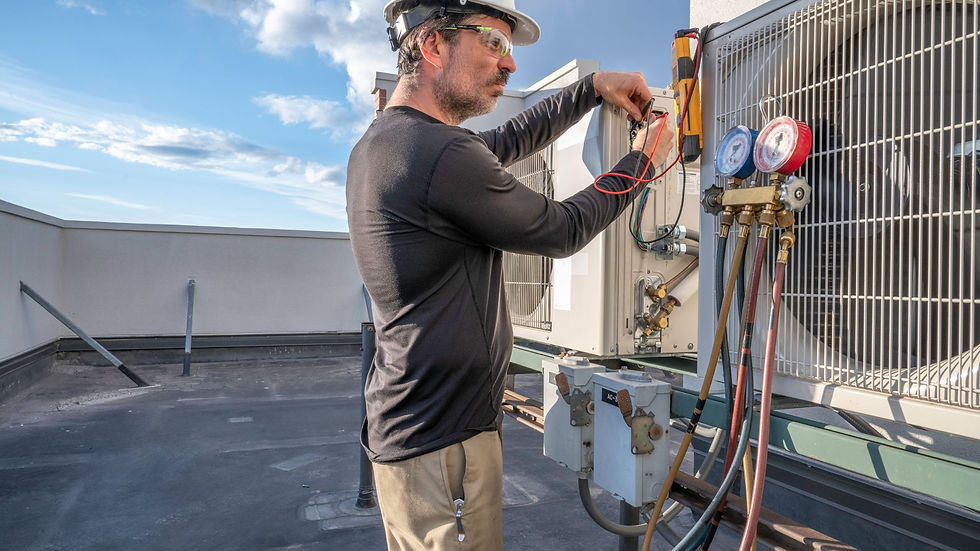
Identifying electrical inefficiencies in March prevents mid-July shutdowns.
Airflow, Static Pressure & System Balance
Commercial HVAC systems are engineered to operate within specific airflow parameters. When airflow falls outside design targets, equipment works harder, consumes more energy, and experiences accelerated wear.
Airflow issues do not always feel dramatic. Instead, they manifest gradually:
Uneven temperature zones
Longer run times
Reduced comfort in high-occupancy areas
Increased utility costs
During our pre-season assessments, we measure:
Total external static pressure (TESP) compared to manufacturer limits
Supply and return pressure differential
Estimated delivered airflow (CFM) relative to design tonnage and specifications
Filter loading and measured pressure drop
Belt condition, tension, and pulley alignment
Economizer damper modulation and response
Coil cleanliness and heat transfer efficiency
High-efficiency filtration without proper static pressure monitoring can restrict airflow and increase motor strain. Belt misalignment can reduce blower performance. Dirty coils reduce heat transfer and force compressors to run longer.
Cooling season does not tolerate airflow inefficiencies. It amplifies them.
Condensate & Moisture Management
Houston’s humidity introduces another layer of operational risk.
Condensate systems that function adequately in mild conditions may struggle under heavy cooling demand. When units run continuously, condensate production increases significantly.
We evaluate:
Condensate drain line integrity and slope
Flow rate and obstruction risk
Drain pan condition and corrosion
Float switch functionality
Evidence of standing water
Condensate failures in commercial buildings can lead to:
Ceiling tile damage
Interior water intrusion
Tenant complaints
Mold exposure risk
Business disruption
Moisture-related issues are rarely catastrophic at first. They begin as slow drains, partial blockages, or aging float switches.
Spring is when these vulnerabilities are easiest to correct - before humidity peaks.
Refrigerant Performance & System Efficiency
Refrigerant imbalances rarely announce themselves as immediate failures.
Instead, they appear as performance drift under increasing load:
Reduced temperature differential across the coil
Extended compressor run times
Higher energy consumption for the same cooling demand
Inconsistent comfort in certain zones
Under mild spring conditions, these symptoms may seem manageable. Under sustained summer operation, they reduce available cooling capacity and increase mechanical stress.
During a structured commercial assessment, we evaluate:
Suction and discharge operating pressures
Superheat and subcooling values compared to design specifications
Compressor discharge temperature
Coil saturation temperatures and approach across the condenser
Measured temperature split across the evaporator
Evidence of oil residue or potential leak indicators
Compressor staging and sequencing performance
Superheat and subcooling readings provide insight into refrigerant charge accuracy and system balance. Elevated discharge temperatures can indicate overwork, airflow restriction, or improper charge conditions.
Minor refrigerant deficiencies that appear stable during moderate load can significantly reduce efficiency and compressor longevity once ambient temperatures climb.
Correcting these performance variables early protects cooling capacity, stabilizes energy consumption, and reduces mid-season compressor risk.
Mechanical Integrity & Vibration Monitoring
One of the most overlooked contributors to commercial HVAC failure is progressive mechanical stress.
Under sustained operation, even minor vibration or imbalance accelerates wear on rotating components and mounting assemblies.
Left uncorrected, these issues compound into bearing failure, shaft misalignment, and motor fatigue.
We evaluate:
Bearing condition and early-stage wear indicators
Shaft alignment and rotational stability
Pulley and sheave alignment
Motor mount integrity
Fan blade balance and structural condition
Abnormal vibration patterns under load
In large rooftop units, vibration is rarely isolated. It transfers through the drive assembly and mounting structure, shortening equipment life across multiple components.
If a vibration is noticeable in March, it will be amplified under continuous operation in July.
Addressing mechanical imbalance early prevents progressive damage during peak cooling demand.
Service History & Pattern Recognition
Commercial HVAC performance is not defined by a single service visit. It is defined by patterns over time.
A structured pre-season assessment includes reviewing documented service history and asset performance trends across the property. We look beyond today’s operating condition to evaluate long-term reliability.
This includes:
Recurring repair trends on specific units
Components replaced repeatedly within shortened intervals
Deferred recommendations that increase exposure under sustained load
Asset lifecycle tracking relative to expected service life
Failure clustering across similar equipment types
Changes in building usage, occupancy density, or internal load conditions
Buildings evolve. Tenant layouts change. Server rooms are added. Operating hours expand. Equipment ages.
As load demands shift, systems that were originally balanced for one operational profile may begin to drift outside optimal performance parameters.
When service data is evaluated collectively - rather than incident by incident - patterns become visible.
Those patterns inform strategic decisions:
Whether a unit is approaching end-of-life
Whether maintenance intervals are compressing
Whether operating costs are trending upward
Whether repair frequency indicates diminishing returns
Ignoring these signals leads to reactive service cycles and unplanned capital expense.
Recognizing them allows facility managers to align HVAC planning with operational budgeting and long-term asset strategy.
Why Timing Matters With Your HVAC Assessments
Once sustained cooling demand begins, operational flexibility narrows significantly.
Rooftop units move into extended run cycles with limited recovery time. Any adjustment that requires system shutdown, staging interruption, or component replacement becomes more disruptive.
During peak summer conditions:
Equipment operates closer to maximum rated capacity for sustained periods, reducing margin for mechanical tolerance
Small electrical or airflow inefficiencies accelerate wear exponentially
Compressor and motor stress increases under elevated ambient temperatures
Lead times on commercial components - including motors, contactors, and larger assemblies - can extend as regional demand spikes
Emergency service often carries labor premiums and limited scheduling windows
More importantly, mid-season corrections rarely occur under ideal conditions.
Access to rooftop equipment becomes more difficult during extreme heat. Tenant complaints increase sensitivity to downtime. Mechanical rooms are hotter. Technicians have fewer controlled testing windows because systems cannot be taken offline for extended evaluation.
Spring assessments provide something peak season cannot: controlled diagnostics under moderate load.
That control allows facility managers to:
Correct developing weaknesses before they compound
Budget proactively rather than reactively
Avoid emergency service premiums
Reduce exposure during the highest-demand months
Cooling season in Houston is predictable. Operational disruption does not have to be.
A Strategic Approach to Cooling Season
If your property has not completed a documented pre-season HVAC performance assessment, you are entering peak cooling demand without verified load readiness.
Spring provides the final controlled window to correct developing weaknesses before sustained operation limits flexibility.
Schedule your cooling readiness evaluation now - before demand removes your margin for adjustment.
Velocity Air A/C & Heating
Commercial HVAC performance. Delivered with precision.


Comments